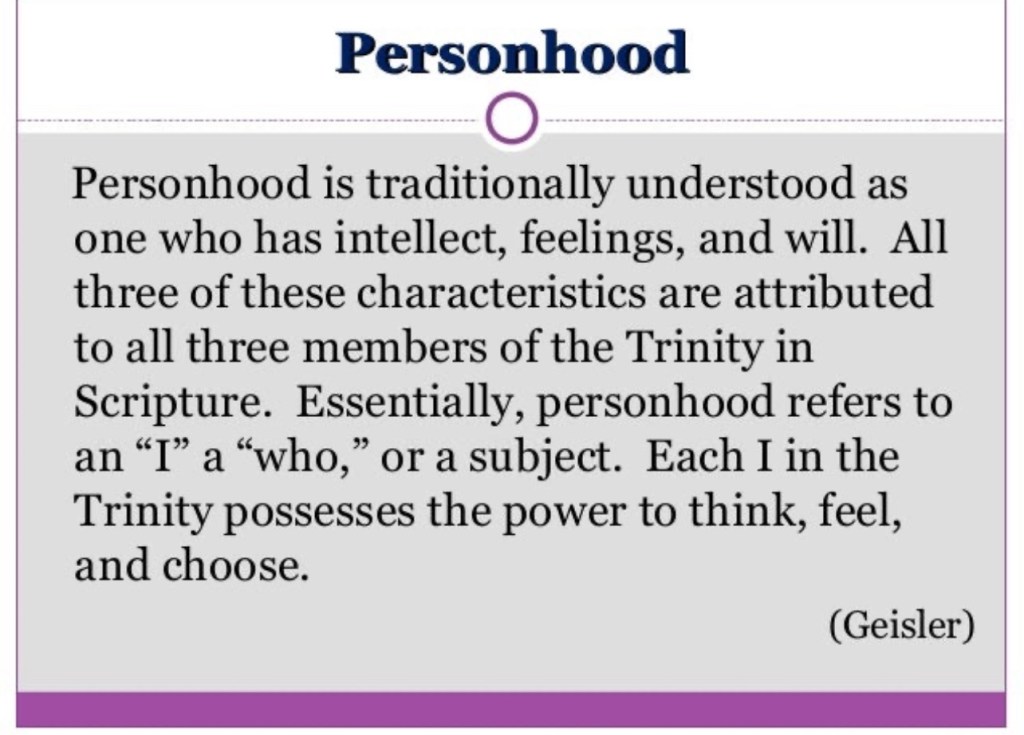
Status of being a person
Personhood is the status of being a person.
Defining personhood is a controversial topic in philosophy and law and is closely tied with legal and political concepts of citizenship, equality, and liberty. According to law, only a legal person has rights, protections, privileges, responsibilities, and legal liability.
Dictionary
personhood | ‘parsnhud | noun
- the quality or condition of being an individual person
Oxford Dictionary
personhood (n.)
“quality or condition of being an individual person,” 1878, from person + -hood.
person (n.)
c. 1200, persoun, “an individual, a human being,” from Old French persone “human being, anyone, person” (12c., Modern French personne) and directly from Latin persona “human being, person, personage; a part in a drama, assumed character,” originally “a mask, a false face,” such as those of wood or clay, covering the whole head, worn by the actors in later Roman theater. OED offers the general 19c. explanation of persona as “related to” Latin personare “to sound through” (i.e. the mask as something spoken through and perhaps amplifying the voice), “but the long o makes a difficulty ….” Klein and Barnhart say it is possibly borrowed from Etruscan phersu “mask.” De Vaan has no entry for it
From mid-13c. as “one of the persons of the Trinity,” a theological use in Church Latin of the classical word. Meanings “one’s physical being, the living body” and “external appearance” are from late 14c. In grammar, “one of the relations which a subject may have to a verb,” from 1510s. In legal use, “corporate body or corporation other than the state and having rights and duties before the law,” 15c., short for person aggregate (c. 1400), person corporate (mid-15c.).
The use of -person to replace -man in compounds for the sake of gender neutrality or to avoid allegations of sexism is recorded by 1971 (in chairperson). In person “by bodily presence” is from 1560s. Person-to-person (adj.) is attested by 1919, originally of telephone calls; the phrase itself was in use by 1880 in reference to the spreading of diseases.
also from c. 1200
Entries linking to person
gender-neutral alternative to chairman, chairwoman, by 1971, American English, from chair (n.) + person.
1911 (OED finds an isolated use from 1842), from inter- “between” + person (n.) + -al. Introduced in psychology (1938) by H.S. Sullivan (1892-1949) to describe behavior between people in an encounter. Related: Interpersonally.
- parson
- persona
- personable
- personage
- personal
- personhood
- personify
- salesperson
- See all related words (10) >
Étymologie Source: https://www.etymonline.com/word/personhood
Excerpt from: https://www.askdifference.com/individual-vs-entity/
An individual is specifically a single human being or organism distinguished from a group. In contrast, an entity encompasses any being, including individuals, corporations, states, or organizations that can be identified as a single unit.
The term individual often refers to personal, human aspects, emphasizing uniqueness and personhood. Entity, however, is a more impersonal term that could refer to any reality capable of being distinct and independent, including legal, corporate, or supernatural beings.
In legal contexts, an individual has rights, responsibilities, and social roles linked to personhood. An entity is recognized in law as having certain legal rights and obligations, but it is not limited to natural persons; it also includes legal persons such as companies or governments.
When considering accountability, an individual is responsible for their actions to a community or society. In the case of an entity, especially a non-human one, it often requires a group of individuals (such as directors or officers) to act and make decisions on its behalf.
In summary, an individual is typically a single human being with personal attributes and social roles, while an entity is a broader concept that includes not only individuals but also groups, organizations, and other corporate or governmental units.
 Encyclopedic Studies & Archives